> For the complete documentation index, see [llms.txt](https://docs.alternativepayments.io/llms.txt). Markdown versions of documentation pages are available by appending `.md` to page URLs; this page is available as [Markdown](https://docs.alternativepayments.io/getting-started/3rd-party-tools/rewst.md).
# Rewst
Many MSPs use **Rewst** to automate workflows across PSA tools, billing systems, and third-party platforms. To enable automated invoice payments and customer operations via **Alternative Payments**, you’ll need to authenticate and interact with our API directly through Rewst using HTTP Request blocks.
This guide walks you through how to **authenticate with the Alternative Payments API** inside Rewst, so you can securely trigger additional API calls from your workflows.
***
## :notebook\_with\_decorative\_cover:How It Works
Rewst supports HTTP requests through its workflow automation engine, allowing you to interact directly with external APIs like Alternative Payments.
To integrate with our API:
* **Authenticate using OAuth 2.0:** This authentication method is used to obtain secure, server-to-server access without user interaction.
* **Obtain an access token:** Upon successful authentication, the API returns an `access_token` that is valid for a limited time.
* **Authorize future requests:** Use this token in the `Authorization` header (`Bearer` format) to securely access other endpoints.
* **Follow standard REST practices:** All API interactions are based on REST conventions, using JSON payloads, HTTP methods, and header-based authentication.
***
## :sparkles:Step-by-Step### :closed\_lock\_with\_key: Step 1: Authenticate using HTTP Request Block
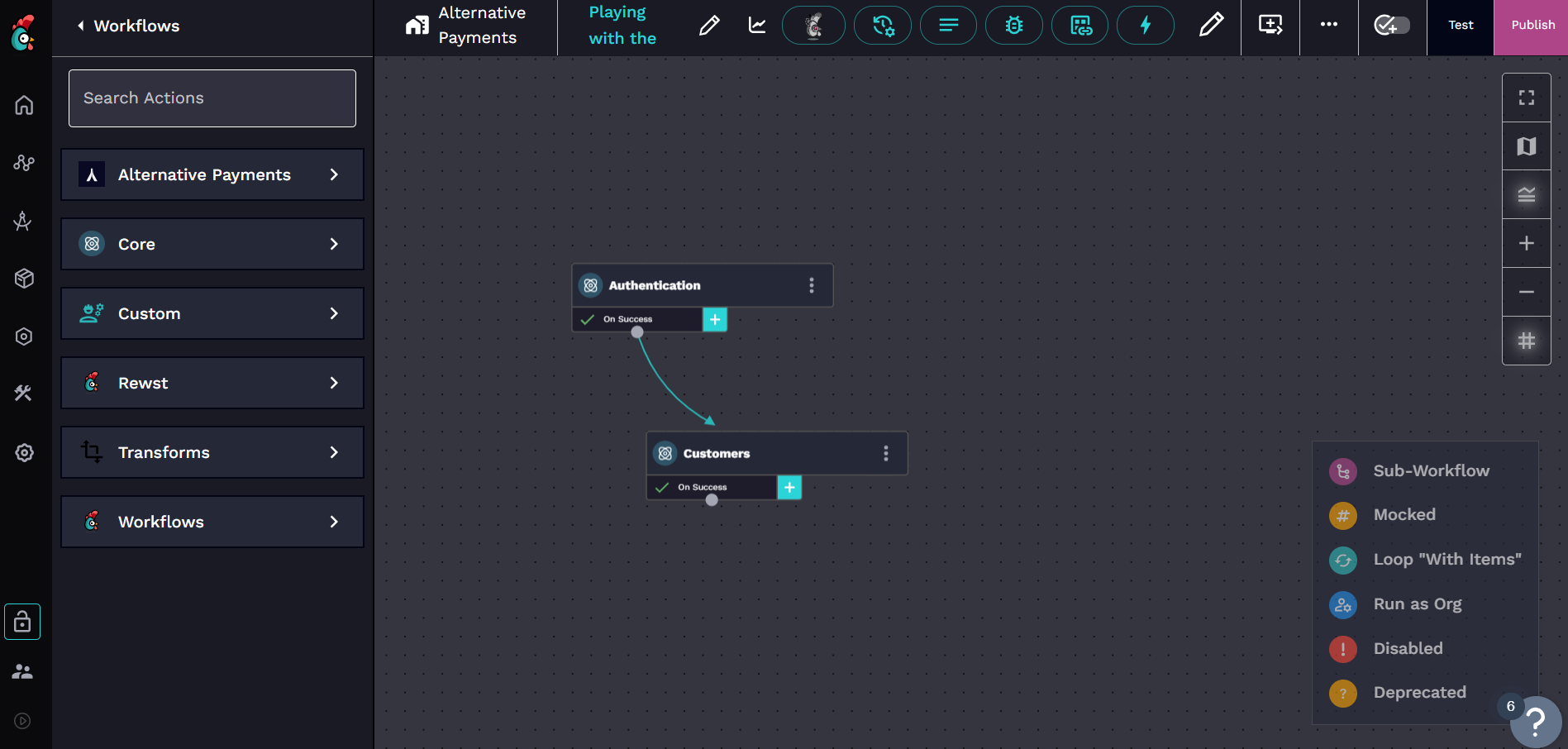
1. In your **Rewst workflow**, click **+** to add a new **HTTP Request** block.
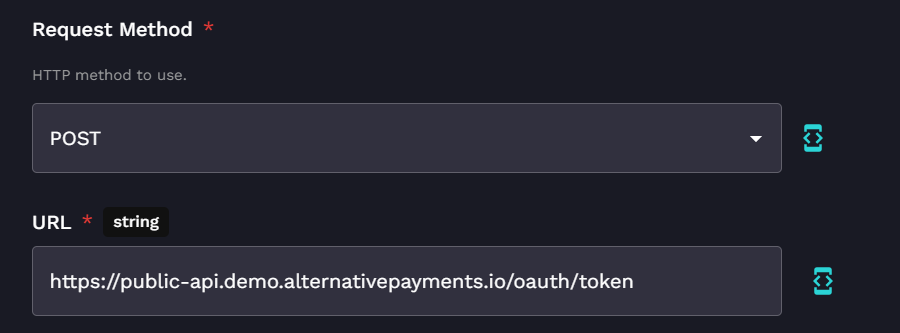
2. Set **Request method** to `POST`.
3. Set **URL** to:
\
In the **Body** section, use:
```
grant_type=client_credentials
```
Set the following **Headers**:
Header
Value
Content-Type
application/x-www-form-urlencoded
Authorization
Basic your_base64_credentials
#### :key: Base64 Credentials
To generate the **base64** credentials:
* Format your credentials as `clientId:clientSecret`
You can find your clientId and clientSecret in the Partner Dashboard under the API Keys section.
* Go to [https://www.base64encode.org](https://www.base64encode.org/).
* Paste the string and click **Encode**.\\
**Example**
Copy the result:
and paste it in the Authorization header as:
```
Basic base64_encoded_value
```
***
### 🧪 Step 3: Test the Request
1. Click **Test** in the HTTP Request block.
2. Then click **View Result**.
✅ If successful, you will receive a JSON response containing:
Copy the `access_token`.
***
### 🔁 Step 4: Use the Token in Future Requests
For any additional API calls (e.g., Listing customers, fetching invoices), include Authorization as a header:
```
Authorization: Bearer access_token
```
#### **📌 Example endpoint:**
**Request**
```
GET https://public-api.demo.alternativepayments.io/customers
```
**Response**
***
## :map:Flow
---
# Agent Instructions
This documentation is published with GitBook. GitBook is the documentation platform designed so that both humans and AI agents can read, navigate, and reason over technical content effectively. Learn more at gitbook.com.
## Querying This Documentation
If you need additional information that is not directly available in this page, you can query the documentation dynamically by asking a question.
Perform an HTTP GET request on the current page URL with the `ask` query parameter, and the optional `goal` query parameter:
```
GET https://docs.alternativepayments.io/getting-started/3rd-party-tools/rewst.md?ask=&goal=
```
`ask` is the immediate question: it should be specific, self-contained, and written in natural language.
`goal` is optional and describes the broader end goal you are ultimately trying to accomplish on behalf of the user. GitBook uses it to tailor the answer towards what is most useful for that goal.
The response will contain a direct answer to the question and relevant excerpts and sources from the documentation.
Use this mechanism when the answer is not explicitly present in the current page, you need clarification or additional context, or you want to retrieve related documentation sections.